 |
Hoskins Family Crest Meanings
Symbols:
The following changes (symbols) appeared at one time, incorporated into Coats of Arms. These symbols allude to deeds accomplished, occupation or other traits for that individual with the same name. You will find the explanations interesting as self-explanatory. Genealogical representation is not intended or implied by this report, and it does not represent individual lineage for your family tree.
Coats of Arms:
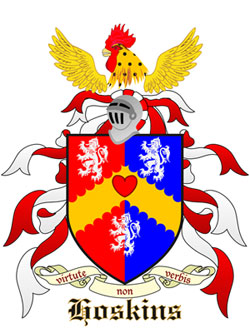
Pale:
A
perpendicular charge occupying the center one-third of the shield. It
represents a pale or fence stake anciently used to enclose a camp. The
pale is the heraldic emblem of a soldier who has entered the enemy's camp
by using military strength to cross fortifications of his foe. It is one
of the most Honourable Ordinaries of heraldry.
Chevron:
This
signifies Protection, and has often been granted in arms as a reward to
one who has achieved some notable enterprise. It is supposed to represent
the rooftree of a house, and has sometimes been given to those have built
churches or fortresses, or who have accomplished some work of Faithful
Service. It is a figure formed by Honour Point. By some heralds, the chevron
is said to represent a saddle, in this guise, it would the symbol of a
mounted man of chivalrous and brave character.
Engrailed:
Formed
with pointed curves like the edges of the Holy Leaf. It implies that the
bearer, like the Holy Leaf, is armed at all points in the Christian cause,
and he who dares approach in hostility may expect conflict. Engrailed
is another accident of form that is believed to indicate, in many instances,
religious persecutions.
Rampant:
means…
Standing
erect on the hind feet and ready for combat. Rampant is admitted to be
the most estimable of all positions. Crest:Cock:The cock is a bird
of great courage, always prepared for battle, and frequently fights to
the death. Being the herald of dawn, it is often used as an emblem of
watchfulness, and may be used in armoury to signify either a hero in the
field or an able man in the senate. It was used in ancient times in Asia
Minor as a symbol of the sun.
Head:
Being
the noblest part of the body is in heraldry the most honourable member.
The position, unless stated in the blazon, is to be facing sideways, on
a profile. Human heads appear to be connected with achievements performed
in reference to religion, particularly at the time of the Crusades and
the Holy Wars. They are symbolic of a fallen enemy.
Pellettee:
Scattered
with pellets (a semee of pellets) which are black roundels.
Wings:
Symbolic
of speed. In the performance of a duty involving a journey into the territory
of the enemy, such as that of an Ambassador. Wings are also believed to
be emblems of paternal care and protection.
The Metals are Argent and Or:
Argent:
Means
silver and is usually depicted in heraldic painting by white. According
to ancient authors, it implies in the bearer purity, innocence, chastity,
truth, justice, and humility. Among the celestial bodies, it is compared
to the Moon; among precious stones, to the Pearl; and among plants, to
the Lily
Or:
Or
means gold and is usually depicted in heraldic painting by yellow. This
metal expresses a metal of all other most brilliant and valuable. As this
metal exceeds all others in value, purity, and virtue. This metal is said
to betoken to the bearer wisdom, riches, and an elevation of mind. It
is compared to the Sun among heavenly bodies; among precious stones it
is assimilated to the Topaz; and among plants to the Cypress tree; with
all the astrological and magical properties of each.
The Colours are Azure, Gules, Vert, Purpure, and Sable:
Azure:
Azure
is the term for blue, representing the colour of the pure blue sky; and
is intended by the herald to imply justice, humility, loyalty, and perseverance.
Among heavenly orbs, it is represented by Jupiter; among stone, by the
Sapphire; and among flowers, by the Violet. Blue is said to represent
heaven, which is the highest of all things created, the tribunal of God,
and the ever-lasting mansion of the blessed.
Gules:
Red,
in the heraldic language is called gules, supposed by some authors to
be derived from the Hebrew word "gulade" (red cloth), by others from the
Arabic "gula" (red rose), but most probably from the French, "guele" (the
mouth of a wild beast), in allusion to its reeking with the blood of a
slaughtered victim. Gules is a royal colour and has long been used an
apparel of majesty. This colour denotes martial prowess, boldness, hardihood,
valour and magnanimity. It is considered to be the most noble of all colours;
it is assimilated to the planet Mars in the heavens; to the Ruby among
stones; and among flowers, the Rose.